

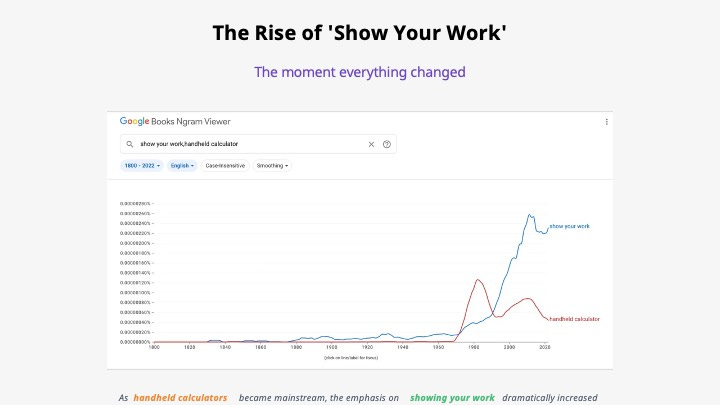
When calculators arrived in classrooms, teachers panicked. If machines could do the math, would students stop learning it? But math didn’t die — it evolved. Teachers simply changed what they valued. Students still had to solve problems, but now they had to show their work.
Today, writing teachers face a similar moment with generative AI. Tools like ChatGPT can churn out essays in seconds. The fear is familiar: if AI can write, why would students bother? But history offers hope. Just as calculators pushed math teachers to focus on reasoning, AI is forcing writing teachers to emphasize process over product. It’s time to ask students to “show your work” in writing — to make their thinking visible.
Calculators Didn’t End Math — They Changed It
When calculators hit classrooms in the 1970s, teachers feared kids would lose basic skills. Instead, they started grading the steps as well as the answers. Even the fanciest TI-82 couldn’t explain its reasoning, so students had to.
This shift made math education stronger, not weaker. Freed from repetitive calculation, students could tackle more complex problems — but only if they could explain how they got there. The result was a deeper focus on logic, communication, and problem-solving.
Calculators didn’t harm math aptitude because teachers kept ownership of the reasoning. The calculator did the grunt work; the student still had to think.
Writing’s “Calculator Moment”
AI is a much bigger leap than the calculator ever was. It doesn’t just compute — it can brainstorm, outline, and draft. That’s why it feels like such a threat to writing instruction. But again, the solution isn’t panic or prohibition; it’s redesign.
If the final essay can be AI-written, then the final essay can’t be the only evidence of learning. The focus must shift to how the essay was made — outlines, drafts, revisions, reflections. The writing process itself is what shows whether a student is doing the thinking.
Make the Thinking Visible
“Show your work” in writing means grading process, not just polish. It’s been a best practice for decades — now it’s a necessity.
Teachers are already adapting:
Carly Ghantous requires brainstorming notes, outlines, and drafts. Each phase earns credit, so the student’s growth is visible.
Steven Krause uses Google Docs version history to watch essays evolve and verify authenticity.
David Cutler has students write in class or on secure digital platforms so he can see their thinking unfold in real time.
Tools like Pressto allow teachers to assign writing plans where students can build their work block by block - it’s like Legos for writing.
Each approach makes it harder to fake a paper — and easier to teach genuine writing skills.
Better Tools for Better Thinking
Ironically, the best defense against AI misuse might be smarter tech. Tools like Pressto are built for this new reality. Its Writing Blocks™ system breaks writing into visible chunks — helping students plan, build, and reflect on their work step by step. Its Real-Time View lets teachers see progress as it happens, offering feedback or encouragement when it matters most.
Instead of policing students, teachers can coach them. Instead of hiding the process, students can proudly show it.
The New Literacy: Thinking in Public
AI isn’t the end of writing — it’s the beginning of a new kind of literacy. When polished text is cheap, authentic thinking becomes priceless.
Math teachers learned long ago that if the answer is easy, the reasoning must matter more. Writing teachers can do the same. Ask students to show their work — and watch their writing (and thinking) grow stronger than ever.
Sources
Cutler, D. Teachers are redesigning writing instruction to outsmart AI. PBS NewsHour.
Ko, A. J. (2023, March 21). What calculators taught us about AI in education.
Krause, S. D. (2023). Teaching writing as a process in the age of AI.
Ghantous, C., & Sell, J. How teachers are adapting to AI in writing classrooms. Education Week.
Shields, C. How to create AI-resistant writing prompts. National Education Association.